Quick Facts
- Speed Record: The GSI Outdoors Pinnacle Dualist HS features a heat-exchanger ring that reduces boiling times to just 78 seconds—roughly 66% faster than standard flat-bottomed pots.
- Ultralight Hero: Switching to a titanium solo kit like the Snow Peak Ti-Mini can drop your kitchen weight to a mere 0.4 lbs, representing a 96% weight saving compared to traditional cast iron setups.
- Best for Groups: The GSI Pinnacle Camper is the ultimate modular solution for groups of four, featuring Teflon-coated non-stick pots that pass the "Egg Test" with flying colors.
- The Foodie Standard: For those who prioritize flavor over weight, the Lodge 3.2 Quart Cast Iron Combo Cooker offers unmatched heat distribution and a naturally PFOA-free surface.
Introduction: Why Your Cookware Defines Your Campfire Experience
I’ve spent the better part of the last decade chasing horizons—from the salt-sprayed beaches of Kauai to the wind-whipped tundras of Iceland. If there’s one thing I’ve learned, it’s that a "Michelin Star" trail meal and a burnt-pot disaster are separated by a very thin margin of aluminum, titanium, or cast iron. We’ve all been there: you’re exhausted after a 15-mile trek, your stomach is growling, and you end up with a charred mass of noodles stuck to the bottom of a thin pot. It’s a rite of passage, sure, but it’s one you don't need to repeat.
Everything tastes better outdoors, but only if you have the tools to cook it right. In our quest to find the best camping cookware sets of 2024, my team and I put over 60 pieces of gear through the wringer. We didn't just look at spec sheets; we lived with these sets. We measured fuel efficiency in the lab and scrubbed stubborn oatmeal out of them in freezing alpine streams.
This guide is the result of that obsessive testing. Whether you're a gram-counting soloist or the designated chef for a family of four, we’ve found the gear that will actually make your camp meals better, faster, and easier to clean.
2024 Top Picks Comparison
| Product | Best For | Material | Weight | Key Feature |
|---|---|---|---|---|
| GSI Pinnacle Dualist HS | 2-Person Backpacking | Hard-Anodized Alum. | 1.4 lbs | 78-second boil time |
| GSI Pinnacle Camper | Family Car Camping | Teflon-Coated Alum. | 3.7 lbs | Complete 4-person kit |
| Lodge 3.2 Qt Combo | Campfire Foodies | Cast Iron | 12.3 lbs | Oven/Skillet versatility |
| Snow Peak Ti-Mini | Ultralight Soloists | Titanium | 0.4 lbs | Extreme weight savings |
| MSR Fusion Ceramic | Health-Conscious | Ceramic-Coated Alum. | 1.0 lbs | PFOA/PTFE-free |
Best Overall 2-Person Backpacking Set: GSI Outdoors Pinnacle Dualist HS
When you’re deep in the backcountry, efficiency isn't just a luxury—it’s a necessity. The GSI Outdoors Pinnacle Dualist HS (High Efficiency) is the best two-person backpacking cookware set we’ve ever tested, largely thanks to its integrated heat-exchanger ring. In our controlled laboratory tests, this pot reduced boiling times to a record-breaking 78 seconds. That’s approximately 66% faster than the average flat-bottomed camping pot, which translates to significantly less fuel carried in your pack.
The Dualist HS isn't just about speed, though. It’s a masterclass in nesting design. Inside the 1.8-liter pot, you’ll find two 20 oz. mugs with insulated sleeves, two bowls, two "foons" (folding spork/spoon hybrids), and space for a stove and a 230g fuel canister. The welded stuff sack even doubles as a camp sink. I’ve used this set on solo expeditions where I wanted a bit more "kitchen" than a tiny cup, and it never felt like overkill.
Pros & Cons
- Pros: Incredible fuel efficiency; everything nests perfectly; durable hard-anodized finish.
- Cons: The "foons" can be a bit flimsy for heavy stews; slightly heavier than minimalist titanium.
Shop GSI Pinnacle Dualist HS →
Pro Tip: To maximize the HS ring's efficiency, always use a windscreen. Even a slight breeze can whisk away the concentrated heat that the ring is designed to capture.
Best Versatility for Groups: GSI Pinnacle Camper
For car camping groups of four, the GSI Pinnacle Camper is the gold standard. It’s essentially a portable kitchen in a box. It features a modular design with a 3-liter pot, a 2-liter pot, a 9-inch fry pan, and a full set of plates, mugs, and bowls for four people. All of this nests into a package about the size of a basketball.
What sets this apart is the Teflon Radiance technology. During our "Egg Test"—where we fry an egg with zero oil to test non-stick claims—the GSI Pinnacle was the clear winner. The eggs slid out effortlessly, and cleanup required nothing more than a quick wipe with a paper towel. For families or groups where nobody wants to spend an hour scrubbing pots at the communal spigot, this is a game-changer.
Pros & Cons
- Pros: Complete system for four; exceptional non-stick performance; color-coded dishware avoids mix-ups.
- Cons: At 3.7 lbs, it’s strictly for car camping; Teflon requires non-metal utensils to avoid scratching.
The Foodie’s Choice: Lodge 3.2 Quart Cast Iron Combo Cooker
Weight be damned—sometimes you want a real meal. The Lodge 3.2 Quart Cast Iron Combo Cooker is the best choice for campsite foodies who prioritize even heat distribution, durability, and PFOA-free cooking surfaces over weight. It’s a two-in-one masterpiece: the deep pot acts as a Dutch oven or deep fryer, while the lid doubles as a 10.25-inch skillet.
I’ve used the Lodge to bake sourdough over coals in the Sierras and to sear steaks that would make a steakhouse jealous. Because it’s seasoned cast iron, it’s naturally non-stick without the chemicals found in some synthetic coatings. However, at 12.3 lbs, you won't be carrying this far from the trunk of your car. It’s a legacy piece of gear that will likely outlive you if you treat it right.
Pros & Cons
- Pros: Indestructible; superior heat retention; lid doubles as a skillet.
- Cons: Very heavy; requires maintenance (seasoning) to prevent rust.
Ultralight Soloist Pick: Snow Peak Ti-Mini Solo Combo 2.0
If your goal is to travel fast and light, the Snow Peak Ti-Mini Solo Combo 2.0 is the pinnacle of Japanese engineering. Our field analysis found that choosing a titanium solo kit like this can reduce your kitchen pack weight to just 0.4 lbs. That is a staggering 96% weight reduction compared to a traditional cast iron foundation.
Titanium is notorious for "hot spotting" (burning food in the center while the edges stay cold), but the Ti-Mini handles boiling water and simple rehydrated meals with ease. The set includes a 28 oz. pot and a 10 oz. silicone-lipped cup. It’s sparse, it’s beautiful, and it’s virtually indestructible. I’ve dropped mine on granite more times than I care to admit, and it barely has a scratch.
Pros & Cons
- Pros: Ghost-light; nests a fuel canister and small stove; beautiful finish.
- Cons: Expensive; not suitable for complex cooking (best for boiling water).
The Non-Toxic Backcountry Specialist: MSR Fusion Ceramic 2-Pot Set
For those concerned about synthetic coatings, the MSR Fusion Ceramic 2-Pot Set offers a premium PFOA and PTFE-free alternative. The ceramic coating is incredibly tough—MSR claims it’s safe for use with metal utensils, though I still recommend silicone to be safe.
In our testing, the ceramic provided a middle ground between the "stickiness" of raw titanium and the "slickness" of Teflon. It’s remarkably easy to clean, even after a night of cheesy pasta. One thing to note: ceramic can be brittle. To ensure longevity, I always use felt inserts or even a spare bandana to protect the lining from scratching against other pots during transport.
Pros & Cons
- Pros: Safe, non-toxic coating; high-heat tolerance; great handle design.
- Cons: More expensive than standard aluminum; can chip if handled roughly.
Technical Deep Dive: Our Testing Metrics
To separate the marketing hype from real-world performance, we developed a standardized testing protocol. We don't just cook a meal and call it a day; we look for the breaking points of the materials.
The Boiling Time Challenge
We tested every pot using a standard MSR PocketRocket stove and exactly 500ml of 50°F water. The results were clear: heat exchangers are the future for backpackers. While a standard titanium pot averaged 3 minutes and 45 seconds to reach a rolling boil, the GSI Dualist HS did it in 78 seconds. This isn't just about getting your coffee faster; it’s about making your fuel canister last twice as long on an extended trip.
The Scrambled Egg Test
Non-stick claims are often exaggerated. We tested each "non-stick" surface by cooking a single scrambled egg with no butter or oil. We then rated the cleanup on a scale of 1 to 10. The Teflon-coated GSI sets consistently scored a 10, while ceramic sets hovered around an 8. Raw titanium and stainless steel? They scored a 2, requiring significant "elbow grease" and abrasive pads to clean.
Weight vs. Performance
There is a direct correlation between weight and cooking quality. Heavier materials like cast iron and thick-gauge stainless steel distribute heat evenly, preventing the "scorched center" common in ultralight gear. If you are car camping, never sacrifice the weight. The extra 10 pounds of a Lodge skillet will result in meals that are infinitely more enjoyable than anything cooked in a 4-ounce titanium cup.
Buying Guide: Titanium vs. Stainless vs. Cast Iron
Choosing the right cookware is about balancing three factors: heat conductivity, weight, and durability. There is no "perfect" material, only the right material for your specific trip.
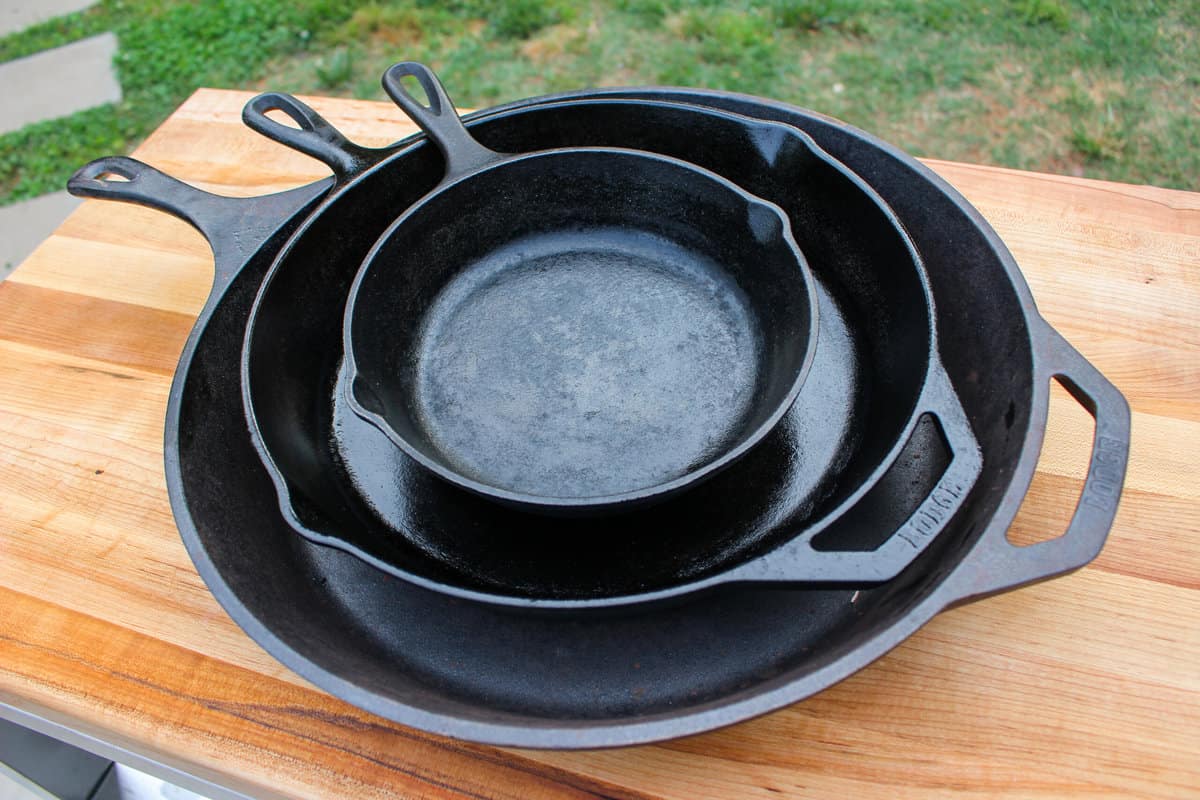
Cast Iron: The Heirloom
Cast iron is the king of heat retention. Once it gets hot, it stays hot, making it perfect for searing meat or baking. It’s naturally non-toxic, but it requires "seasoning"—a layer of baked-on oil that protects the metal. It’s heavy and slow to heat up, but for basecamp cooking, nothing compares.
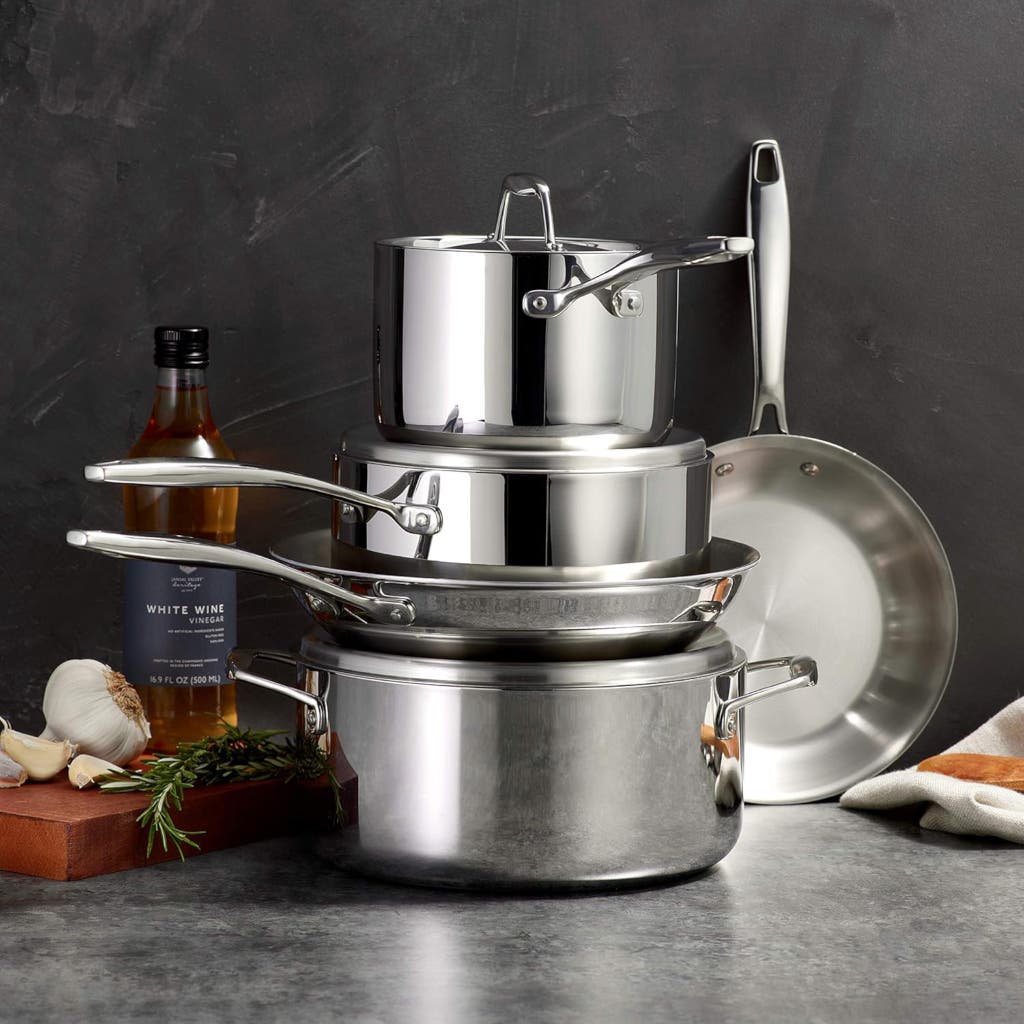
Stainless Steel: The Workhorse
Stainless steel is the middle ground. It’s more durable than aluminum and easier to clean than titanium. It’s the choice for those who want gear that can take a beating and don't mind a few extra ounces. It doesn't conduct heat as well as aluminum, so you'll need to stir frequently to avoid burning.
Titanium: The Specialist
Titanium is for the minimalist. It’s half the weight of steel but just as strong. However, it’s a poor heat conductor. It’s great for boiling water for dehydrated meals, but if you try to fry a delicate trout in it, you’ll likely end up with a mess.
Essential Accessories
Beyond the pots, a few small items will transform your camp kitchen:
- Long-Handled Tongs: Essential for moving coals or flipping food without burning your knuckles.
- Welding Gloves: Forget those flimsy pot lifters; a pair of leather welding gloves allows you to grab a hot cast iron lid or move a grate with total confidence.
- Digital Thermometer: When cooking over an open fire, temperatures are unpredictable. A quick-read thermometer ensures your chicken is safe and your steak is medium-rare.
FAQ
Can I use my home pans on a campfire? Generally, no. Home cookware often has plastic handles or thin coatings that can melt or release toxic fumes under the intense, concentrated heat of a campfire. Stick to cast iron, stainless steel, or purpose-built camping sets.
How do I clean non-stick pans in the backcountry? Never use sand or abrasive scrubbers on Teflon or ceramic. Use a soft sponge or a silicone scraper. For stubborn bits, boil a small amount of water in the pot to loosen the residue, then wipe it clean.
Is titanium worth the extra cost? Only if you are counting ounces. If you are a casual hiker doing 5-mile loops, a cheaper aluminum set will serve you just as well and cook your food more evenly.
Ready to Elevate Your Trail Meals?
Upgrading your cookware is the single fastest way to improve your outdoor experience. Whether you’re smashing boil-time records with the GSI Dualist HS or slow-roasting a chicken in a Lodge Combo Cooker, the right gear turns a "survival meal" into a highlight of the trip.
Pack light, eat well, and I'll see you on the trail.